Industrial Manufacturing
Evan Glassman
•
August 13, 2026
5 minutes

Some manufacturing projects simply make more sense close to home.
Utah has always been a place where unusual industries grow out of an unusual landscape. The Great Salt Lake is perhaps the best example.
Its extreme salinity supports populations of brine shrimp, known as Artemia, whose cysts and biomass are important products for aquaculture and fish food. Harvesting them requires boats, pumps, specialized equipment, and some surprisingly serious sewing.
Recently, Utah Contract Sewing completed a production run of 200 heavy-duty Artemia harvesting bags for Great Salt Lake Artemia, bringing together material sourcing, industrial sewing, and specialty manufacturing here in Utah.
These aren’t ordinary bags. Each is designed to handle up to approximately 1½ tons of harvested brine shrimp in demanding commercial harvesting conditions.
That is roughly the weight of a small car.
Suddenly, stitch selection becomes considerably less theoretical.
Built in Utah for Work on the Great Salt Lake
There is something satisfying about this project being manufactured here.
A Utah company needed highly specialized textile equipment for a uniquely Utah industry—and another Utah company could make it.
Utah Contract Sewing sourced the technical textiles, webbing, notions, hardware, and other components required for the project and coordinated production of 200 completed harvesting bags in approximately six weeks.
That production window illustrates one of the often-overlooked strengths of domestic manufacturing.
For specialized industrial products, seasonal equipment, evolving designs, and production quantities measured in hundreds rather than tens of thousands, regional manufacturing can make practical sense.
Customers can work directly with the people sourcing materials and building their products, making it easier to address questions, coordinate production, and respond when requirements change.
What Heavy-Duty Industrial Sewing Requires
Industrial sewing occupies an interesting territory somewhere between textile manufacturing and engineering.
Once products become large, heavy, structural, or load-bearing, ordinary sewing techniques are no longer enough. Material selection, thread, webbing, seam construction, and reinforcement all matter.
And the machines matter.
At Utah Contract Sewing, we maintain more than 20 different types of industrial and specialty sewing machines, allowing our team to work across a broad range of technical materials and construction requirements.
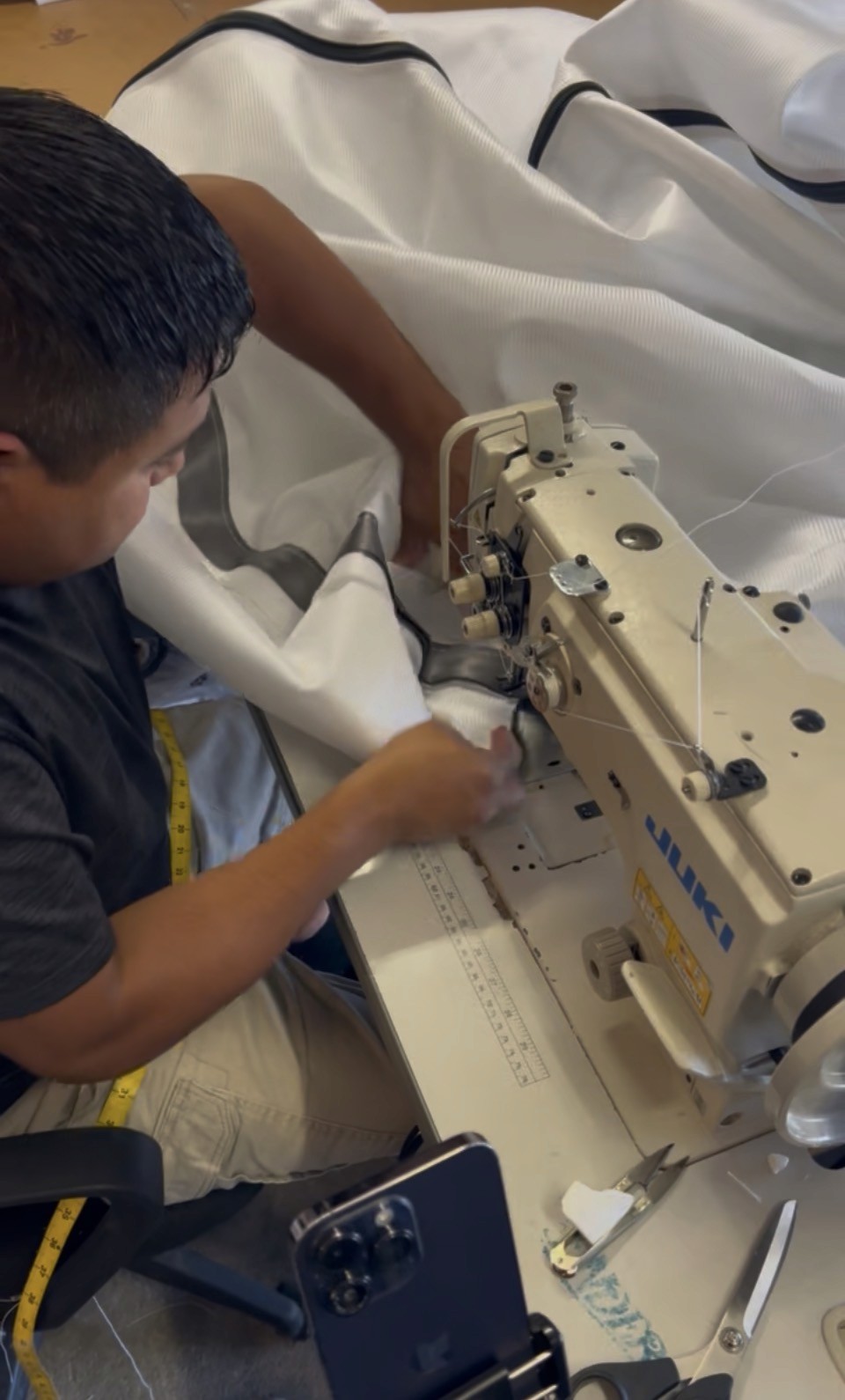
The scale of the Artemia bags becomes apparent when they’re sitting beside the sewing machine. Large textile assemblies must be maneuvered, controlled, and sewn accurately while incorporating substantial webbing and reinforced components.
That takes both appropriate machinery and an experienced production team.
With decades of combined industrial sewing experience, our team understands how heavy textile assemblies behave during construction and how manufacturing decisions affect their intended use.
We aren’t limited to making something that already exists. We can help determine how it should be made.
Why Domestic Manufacturing Still Matters
Overseas manufacturing can make tremendous sense for high-volume products with predictable, continuous production.
But that is not every product.
A specialized company might need 100 pieces this month, 300 next season, and a modified version six months later. It might need a prototype quickly or discover a better material during development.
Industrial equipment, agricultural products, outdoor products, medical soft goods, specialty bags, covers, and custom textile assemblies frequently require smaller production quantities, periodic manufacturing runs, or ongoing design changes.
In those situations, the lowest quoted unit price does not necessarily produce the lowest total cost.
Working with a domestic specialty manufacturer can offer:
Faster turnaround and replenishment
Practical production quantities
Direct communication with the production team
Easier prototyping and construction changes
Simpler freight and logistics
Closer quality control
Greater flexibility for seasonal or intermittent production
Time has a cost. Inventory has a cost. Freight has a cost. Mistakes have a cost.
Sometimes the most efficient supply chain is simply the one where the people designing, sourcing, and manufacturing the product can actually talk to each other.
From the Sewing Machine to the Boat
The white textile assemblies moving across our production floor ultimately become working industrial equipment aboard harvesting vessels on the Great Salt Lake.
During harvesting, the bags become part of a much larger system of pumps, hoses, vessels, and processing equipment. Filled with harvested Artemia, they’re no longer abstract sewn products.
They’re tools.
This is one of our favorite things about specialty manufacturing: seeing something leave the sewing floor and enter the real world.
Sometimes that world happens to be one of the strangest and most beautiful bodies of water in North America.
For this project, the connection between manufacturing and use is especially clear. The bags were made in Utah to support an industry operating on Utah’s Great Salt Lake.

A Manufacturing Partner for the Mountain West
From our Utah facility, Utah Contract Sewing serves companies throughout Utah, Idaho, Wyoming, Montana, Colorado, Nevada, and the greater Western United States.
Regional proximity matters when a product is being developed, when specifications change, and when a customer needs a specialized production run.
There is an important manufacturing economy between the prototype shop and the massive factory.
That’s where Utah Contract Sewing lives.
Our capabilities include industrial sewing, technical sewing, product development, rapid prototyping, material sourcing, specialty textile fabrication, and short-to-medium production runs.
We work with entrepreneurs, engineers, established companies, and industrial customers on products including:
Outdoor equipment and technical bags
Industrial sewn products and equipment covers
Medical soft goods
Specialty textile assemblies
Inventions and functional prototypes
Products combining soft and hard components
These projects often don’t fit neatly into a conventional apparel factory. They require an understanding of materials, construction, intended use, and practical production methods.
From a single prototype to a few hundred specialized production pieces, our goal is straightforward:
Figure out how to build it well—and then build it.
The Great Salt Lake Artemia project is a pretty good example.
Two hundred specialty harvesting bags. Approximately six weeks. Made in Utah.
And now they’re out on the Great Salt Lake doing their job.
Utah Contract Sewing helps entrepreneurs and businesses move from early concepts through prototyping and production preparation.
Tell Us About Your Project
More from the Blog
Industrial Manufacturing
August 4, 2026
Product Development
August 4, 2026
Manufacturing
August 4, 2026
Soft goods design, prototyping, and production. Based in Salt Lake City, working with clients nationwide.
2030 S 900 E Ste E, Salt Lake City, UT 84105
© 2026 Utah Contract Sewing. All rights reserved.